
Introduction
Many businesses start short daily meetings, but within a few weeks the meetings drag on, turn into data discussions or are quietly dropped. The problem is usually not the meeting itself but its setup: the indicators are unclear, the visual board is disconnected from the place where the work happens and the actions have no owners.
In this article we explain how to set up an Asakai routine that really works on the shopfloor in five steps, what to avoid and how to manage the first 30 days.
Step 1: Choose the Right Indicators
Choose four to six indicators covering safety, quality, delivery, productivity and cost. Too many indicators turn the meeting into a data presentation. Three things must be clear for each indicator:
Step 2: Set Up a Visual Board on the Shopfloor
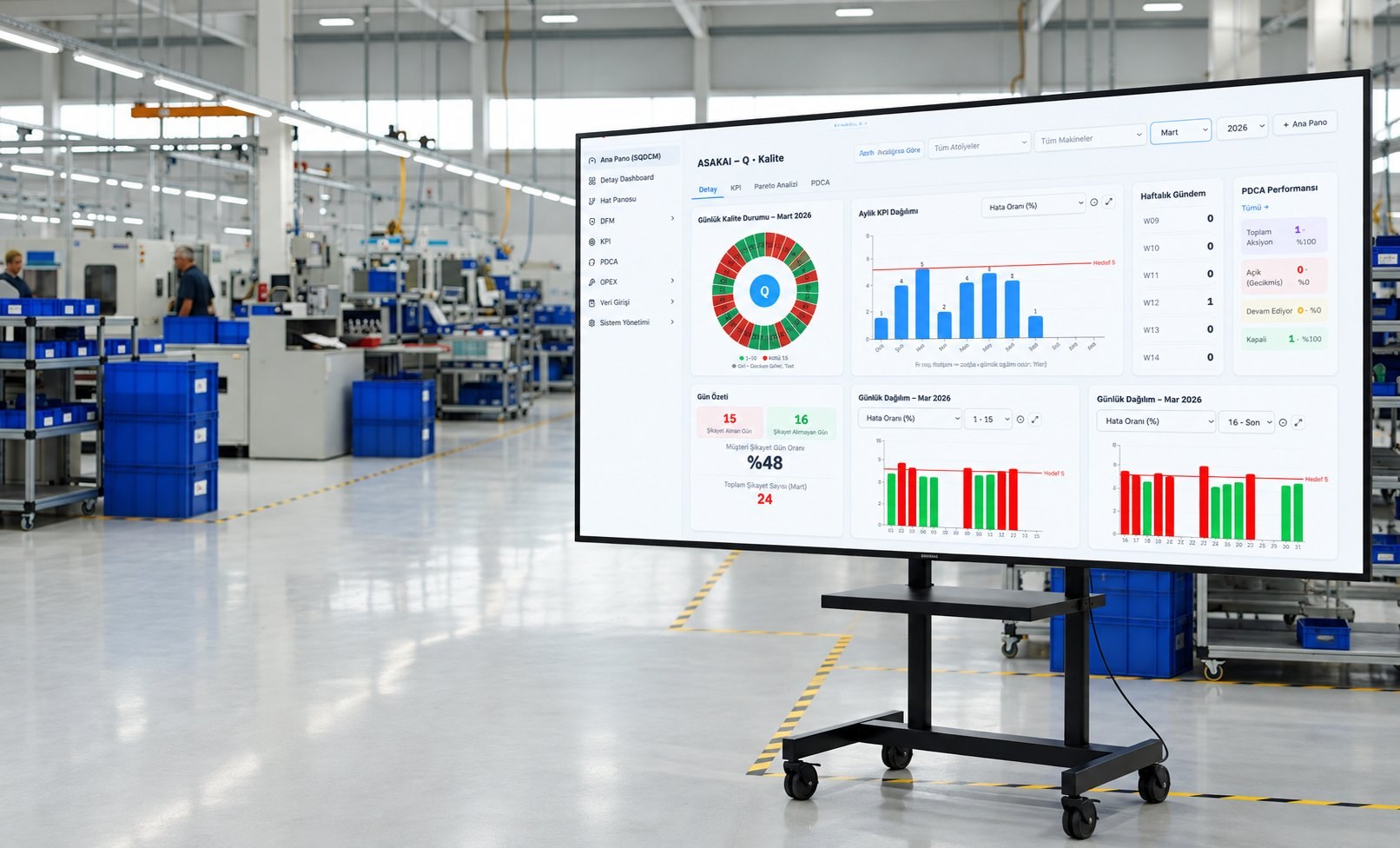
The board must be where the work is done; a board moved to the meeting room detaches the meeting from the shopfloor. The board should show the following at a glance:
- Target, actual and deviation
- Color-coded status (on target / off target)
- Open actions, their owners and due dates
You can start quickly with a physical board and move the same structure to a digital board once the routine has settled.
Step 3: Fix the Time and the Agenda
Hold the meeting at the same time every day. Keep it standing and limit it to 10–15 minutes. The agenda order is fixed: safety, yesterday's results, deviations, today's risks, action tracking and escalation.
Step 4: Define Roles and Action Tracking
Three roles are enough for the meeting to work: the leader who runs the meeting, data owners who keep each metric accurate and up to date and the action owners who carry out the actions. Every action must have a single owner and a due date; "we'll look at it as a team" does not count as an action.
Step 5: Build an Escalation Path to the Next Level
Define the rule in advance for issues that cannot be resolved on the shopfloor: for example, any deviation not closed within 24 hours or that requires authority or resources beyond the team's scope is escalated to the meeting one level up. If the escalation path is unclear, problems pile up on the board.
Common Mistakes
- Moving the meeting from the shopfloor to the meeting room
- Tracking too many indicators
- Not assigning owners and dates to actions
- Trying to do root cause analysis during the meeting
- Lack of leadership support or an effective escalation path
- Blaming individuals instead of addressing process deviations
Sample Asakai Flow: A 12-Minute Plan
The flow below can be used as a starter template for a single-shift line.
Implementation Plan for the First 30 Days
Behavior Rules for the Meeting Leader
- Start the meeting on time and end it on time
- Talk about the deviation, not the person
- Steer the discussion toward assigning an owner and a date
- Apply the rules and format yourself first
How Do You Measure Success?
- Adherence to meeting duration
- Attendance rate
- On-time action closure rate
- Number of recurring problems
Conclusion
Daily operational control is built on the right indicators, a visual board on the shopfloor, a fixed agenda and clear ownership. Once the format has settled, the same structure can be moved to a digital system and scaled across departments while giving each management level the visibility it needs.
Frequently Asked Questions
What time of day should the Asakai meeting be held?
Right before the start of the shift or within the first hour, at the same time every day, works best. What matters is that the time is fixed.
Which indicators should I track?
Choose four to six indicators covering safety, quality, delivery, productivity and cost. Each indicator should have a target, a measurement method and an owner.
What should I do if the meeting runs long?
Do not discuss issues that need solving in the meeting; turn them into an action with an owner and a date. Do the root cause analysis outside the meeting.
Should I use a physical board or a digital board?
Both work. A physical board enables a quick start; a digital board makes automatic data feeds, history tracking and multi-department visibility easier.
How is it applied across multiple shifts?
Each shift holds its own short meeting; handover between shifts is carried out on the same board and the same indicators.
Do I need a digital system to get started?
No. A disciplined format and clear responsibilities are enough. A digital system is introduced to scale once the meeting routine has settled.